TL;DR
Living in Kensington Calgary offers an authentic urban lifestyle shaped by historic homes, independent businesses, rapid transit and exceptional Bow River access. Residents gain walkable daily amenities and a strong community network, balanced against competitive housing, weekend activity, parking controls and the realities of inner-city density.
Understanding Hillhurst, Sunnyside and the Commercial Core
Kensington is a Business Improvement Area centred on 10 Street NW and Kensington Road NW. The surrounding homes belong primarily to Hillhurst and Sunnyside, though residents commonly use “Kensington” for the entire district.
The broader area extends from the Bow River north toward McHugh Bluff. Sunnyside runs east to Centre Street and west to 10 Street NW. Hillhurst continues west toward 14 Street and, in places, 18 Street NW. Together, these communities form the residential foundation of Kensington Village Calgary.
The streets reveal more than a century of growth. Sunnyside began with modest Canadian Pacific Railway worker cottages, many built on narrow 25-foot parcels. West of Sunnyside, Ezra Riley’s estate helped shape Hillhurst. Riley donated the land that became Riley Park, now one of the district’s defining green spaces.
Community activism also influenced the neighbourhood. Residents opposed plans to turn Memorial Drive into an expressway and pushed for more thoughtful redevelopment. That civic tradition continues through the Hillhurst Sunnyside Community Association, known as HSCA.
Hillhurst and Sunnyside are represented within Calgary’s Ward 7. The BIA supports merchants, events and commercial streets, while HSCA focuses on residents, services and local advocacy. Buyers should understand this distinction because property searches, community data and planning policies use Hillhurst or Sunnyside, not Kensington.
Why Is Kensington Considered Calgary’s Coolest Neighbourhood?
Kensington earns that reputation through pedestrian-focused historic streets, immediate river access and a dense collection of independent businesses. Its character feels organic rather than master-planned, with local culture embedded in repurposed buildings, patios and public spaces.
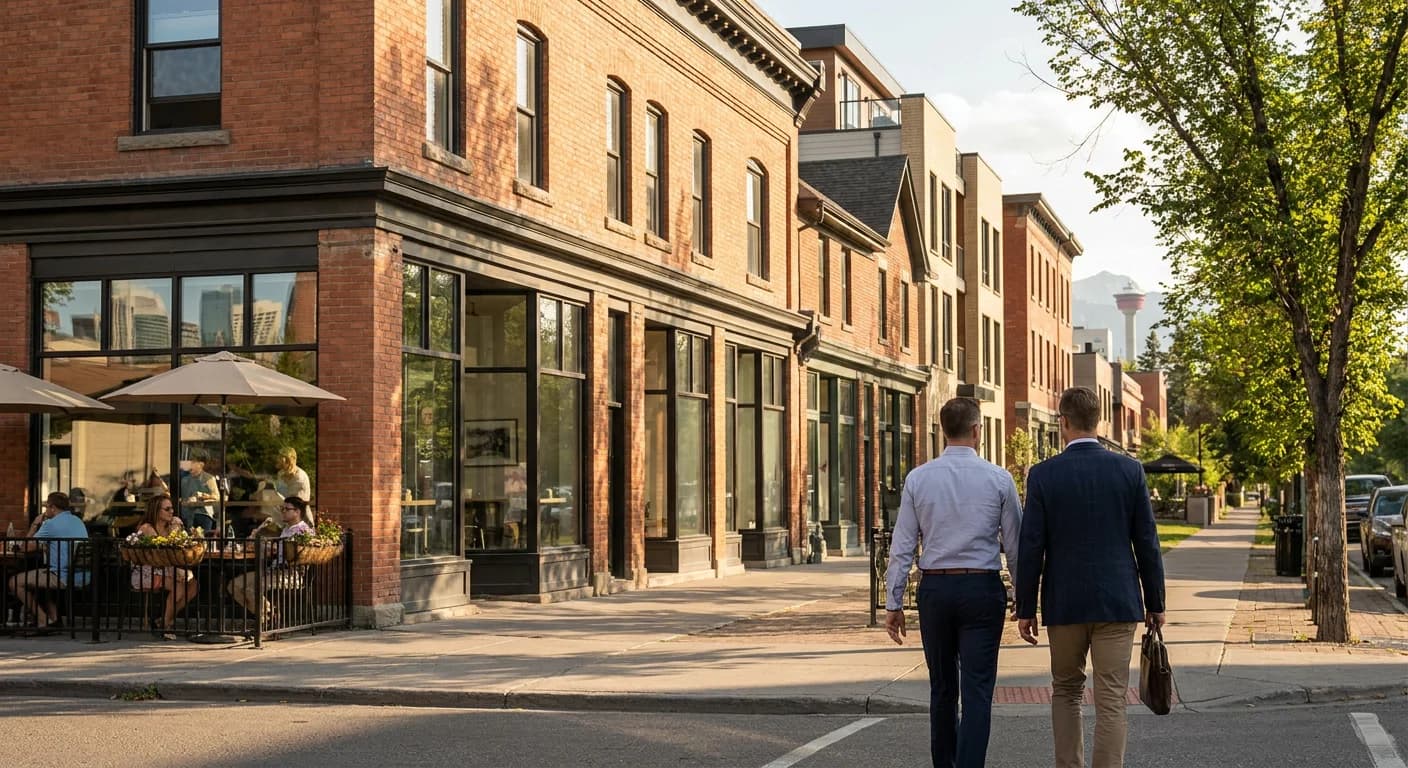
Municipal and national travel features regularly position the district among Calgary’s most engaging destinations. The appeal begins with its physical form. Historic brick storefronts, mature streets and older landmarks create a human-scaled setting. Shops open directly onto the sidewalk, keeping 10 Street NW and Kensington Road active throughout the day.
The Plaza Theatre is a central cultural landmark. The independent cinema occupies a converted 1920s automotive garage and hosts films and community programming. Nearby, the Kensington Art Walk connects murals, sculptures and outdoor installations across the commercial district. Tourism Calgary’s Kensington neighbourhood guide captures this combination of creative venues, dining and public art.
Patios and compact storefronts give the area a social rhythm rarely found in conventional suburban retail centres. Visitors move naturally between coffee shops, boutiques, restaurants and the river pathway.
In my experience, clients drawn to this area are buying more than a home. They are choosing an established street culture with strong local identity. That distinction is central to any useful Kensington neighborhood guide.
What Is Living in Kensington Calgary Like Day to Day?
Daily life feels convenient, social and distinctly urban. Most errands can be completed close to home, while active commercial corridors bring visitors, events and a noticeable weekend pulse.
The Hillhurst Sunnyside community has strong social infrastructure. HSCA operates community facilities and supports childcare, seniors’ outreach, collective kitchens and youth programming. Its markets and food initiatives also create regular meeting points for neighbours. The association’s community programs illustrate how much local life extends beyond restaurants and retail.
That energy creates practical trade-offs. Homes near 10 Street NW, Kensington Road or Sunnyside Station experience more pedestrian traffic. Restaurant activity, deliveries and seasonal events can add noise. Street parking is regulated, and residents may need permits where restrictions apply.
Safety should be assessed with context rather than broad assumptions about the inner city. Sunnyside recorded 10 crimes in June 2026, with 115 incidents over the preceding 12 months. That equals an average of 9.6 reported crimes per month. Hillhurst recorded 14 incidents that June and 164 across the same annual period.
Property crime remains the most relevant concern for many residents. Secure garages, controlled building access and sensible bike storage matter. At the same time, active sidewalks, visible businesses and neighbourhood cohesion support comfort during both daytime and evening hours.
I advise buyers to visit a prospective block at several times of day. Conditions can differ substantially between a quiet residential avenue and a home beside the commercial spine.
Daily Connectivity: CTrain, Pathways and Car-Light Living
Sunnyside Station anchors the district’s transit network. Red Line trains reach downtown in under five minutes, making the neighbourhood particularly attractive to professionals working in the central business district.
The Bow River pathway provides another direct connection to major employment and recreation areas. Cyclists and pedestrians can travel toward Eau Claire, East Village and other riverfront districts. The Louise Bridge links 10 Street NW with downtown, while the Peace Bridge is accessible from the eastern side of Sunnyside.
Kensington Calgary walkability serves ordinary errands as well. Depending on the block, residents may find groceries, medical services, fitness studios, cafés and specialty retailers within a five-minute walk. That compact amenity base removes the need to drive for every appointment or household purchase.
A car-free lifestyle is realistic for residents whose work and routines align with transit. A car-light approach offers greater flexibility while reducing fuel, insurance and downtown parking expenses. Secure bike rooms and outdoor racks are valuable features when comparing condominiums or rental buildings.
Vehicle owners should investigate residential permit zones before committing to a property. Older cottages and apartment buildings do not always include off-street parking. Winter pathway maintenance, bicycle storage and the distance to Sunnyside Station should also form part of a practical housing assessment.
My clients often discover that the neighbourhood’s mobility options change how they evaluate value. A smaller home can feel more functional when work, recreation and essential services are close at hand.
Streetscape Investments Reshaping the Pedestrian Realm
Public investment is reinforcing the district’s established strengths. The Established Area Investment Fund and Riley Area Improvements have supported safer streets, improved parks and more flexible gathering spaces.
Projects along 19 Street NW, 2 Avenue NW and 3 Avenue NW introduce a more balanced approach to movement. The improvements include all-ages wheeling lanes, curb extensions, traffic calming and raised crossings. Narrower vehicle lanes and shorter crossing distances are intended to slow traffic and improve pedestrian comfort.
The redesigned Kensington Plaza now includes sculptured benches, new trees, updated paving, bike racks and enhanced lighting. Utility improvements support temporary features and community events. The result is a flexible outdoor room rather than a simple passage between businesses.
Park investment extends beyond the commercial core. Riley Park received outdoor climbing and calisthenic equipment with nearby seating. Grasshopper Hill received pathway and accessibility work intended to reduce erosion and preserve the landscape. The City’s Riley Area Improvements outline how these projects respond to growth in established communities.
These changes strengthen Kensington Calgary walkability for children, older adults and everyday cyclists. They also support Kensington Village Calgary as a destination without treating vehicle movement as the only priority. For homeowners, a stronger public realm can protect long-term neighbourhood appeal as density increases.
Local Culture, Independent Shops and Coffee Spots
The independent retail mix is one of Kensington’s strongest competitive advantages. Along 10 Street NW and Kensington Road NW, established institutions sit beside newer concepts, creating a commercial district that rewards exploration.
Pages Books offers three floors of new and used titles, literary events and thoughtful curation. Hot Wax Records has operated since 1978, connecting the district to Calgary’s vinyl and music culture. Canary adds a contemporary sustainability focus through its zero-waste refillery and household products.
Specialty food retailers deepen the experience. Peasant Cheese Shop provides curated cheeses and knowledgeable service. The neighbouring Kensington Wine Market offers a broad selection and pairing expertise. Together, they make gourmet shopping possible without leaving the neighbourhood.
Kensington shops and cafés cover several moods:
- Higher Ground: A long-standing organic and fair-trade coffee destination in a historic building.
- Good Trade: A coffee shop built around social purpose and support for education in Colombia.
- Regal Cat Café: Espresso service paired with an adoption-focused cat lounge.
- Fuwa Fuwa: A specialty destination for Japanese soufflé pancakes.
- Red’s Diner: A popular brunch and casual breakfast institution.
- Vero Bistro: An intimate choice for polished European-inspired dining.
- Hayden Block: Barbecue, whiskey and evening live-music energy.
This variety gives Kensington Village Calgary a complete daily rhythm. Coffee culture drives mornings, retail sustains afternoon activity, and restaurants keep the streets animated into the evening.
Real Estate: Heritage Cottages, Infills and Condos
Housing across Hillhurst and Sunnyside reflects successive periods of Calgary’s growth. Buyers can encounter surviving CPR cottages on 25-foot lots, mid-century bungalows, renovated character homes and luxury contemporary infills within a few blocks.
The multi-family market is equally varied. Sunnyside contains vintage low-rise walk-ups that often provide more attainable rental options. Modern mid-rise condominiums and purpose-built rental buildings appear closer to transit and arterial streets. Townhomes and semi-detached infills fill the space between apartment and detached-home living.
Calgary’s planning framework treats these neighbourhoods as established areas where growth occurs mainly through redevelopment. Local planning policies guide building scale, mobility, servicing and the relationship between new density and existing streets. Buyers should examine surrounding land use alongside the current view from a property.
Broader Calgary inventory gains have improved choice. A late-2025 market analysis reported that Calgary’s composite benchmark price was down about 4.6% year over year. It also noted roughly 26,500 homes under construction and resale inventory at a seven-year high.
Those citywide conditions can create negotiating opportunities, particularly for apartments. However, core riverfront neighbourhoods retain durable appeal because land is limited and amenities are difficult to reproduce.
I assess each property by micro-location, lot quality, building condition and redevelopment exposure. Within the Hillhurst Sunnyside community, two visually similar homes can offer very different privacy, parking and long-term value.
Is a $70,000 Salary Enough to Live in Kensington?
Yes. A $70,000 annual income is generally sufficient for an individual to rent comfortably, especially in older apartment stock. Transit access and active transportation can also reduce the need for vehicle ownership.
For a single renter, living in Kensington Calgary becomes manageable when housing type and discretionary spending are chosen carefully. Gross monthly income at that salary is approximately $5,833. Applying the standard 30% shelter guideline produces a target housing budget of about $1,750 per month.
| Budget measure | Monthly amount |
|---|---|
| Gross income | $5,833 |
| 30% shelter target | $1,750 |
| Calgary purpose-built two-bedroom average | $1,914 |
| Calgary condominium two-bedroom average | $2,030 |
Newer Kensington rentals may exceed citywide benchmarks. Older one-bedroom apartments, basement suites and modest walk-ups can offer better alignment with the shelter target. A two-bedroom may require a roommate, a higher housing ratio or fewer discretionary expenses.
Transportation is the major offset. Using Sunnyside Station, cycling routes and the Bow River pathway can avoid insurance, fuel, maintenance and parking costs. Those savings may support a better-located apartment.
The principal budgeting risk is lifestyle creep. Restaurants, specialty groceries and local boutiques are always close. A deliberate dining and retail budget preserves room for savings while still allowing residents to enjoy the neighbourhood’s defining amenities.