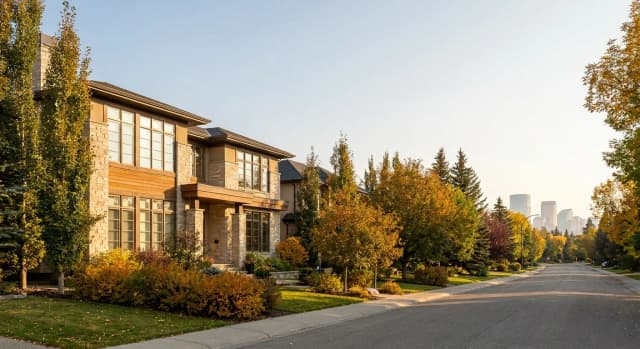
Calgary luxury real estate is having a moment in 2026, and the reasons go well beyond a single hot listing or a good month of sales. The broader market has shifted from the frenzy of recent years into something steadier and more balanced. Yet the high end keeps showing a stubborn strength of its own. I spend my days inside this segment. So I want to walk you through what Alberta's 2026 outlook, the national forecasts, and the province's tightening rulebook mean for high-end buyers and sellers this year.
The city has cooled from a seller's market into balance, prices have eased, and the rules around disclosure and representation keep getting stricter. Even so, well-located luxury homes continue to attract motivated buyers. The gap between the headline averages and the reality at the top is where good decisions get made.
Why is Calgary luxury real estate a standout story in 2026?
Calgary stands out because its high end is holding up while national price growth has gone nearly flat. The Canadian Real Estate Association projects only modest national gains for the year, with virtually no price growth expected in Alberta.
That contrast makes the local strength worth a closer look. According to the CREA quarterly forecast, roughly 474,972 properties will trade hands across Canada in 2026. That is about 1% above the prior year, with the national average price near $688,955. Moreover, Alberta sits in the group expecting essentially flat prices. Against that quiet national picture, though, Calgary keeps drawing buyers who feel priced out of Toronto and Vancouver.
Several forces feed this story at once:
- Population momentum. Calgary has been among the fastest-growing major cities in the country. Notably, a meaningful share of that growth arrives with strong incomes and equity from pricier markets.
- Relative value. For instance, buyers moving from the coasts often find that a Calgary luxury home costs a fraction of a comparable property elsewhere.
- Economic anchors. Energy, finance, and professional services still support a deep pool of high earners who shop at the top of the market.
Because of these drivers, the luxury segment behaves almost like its own market. Reading citywide averages alone will mislead you about what is happening above the $1 million line.
How balanced is the Calgary housing market right now?
The wider market has moved into balanced territory in 2026. Sales have slowed from their peak, inventory has climbed, and prices have softened a little rather than fallen off a cliff.
The local numbers carry the story. Per the Calgary Real Estate Board data for May 2026, the total residential benchmark price sat at $570,500. That marked a drop of about 3% from a year earlier. Furthermore, sales ran roughly 16% below the same month last year, while inventory rose to about 6,752 units. The sales-to-new-listings ratio slipped to 51%, which is the textbook signal of a balanced market where neither side holds all the cards.
Still, the averages hide important differences between property types:
| Segment | What May 2026 showed | What it means for you |
|---|---|---|
| Detached homes | Benchmark near $747,800, with roughly two-and-a-half months of supply | Relatively balanced; quality homes still move |
| Apartments | Benchmark near $300,400, down about 9% year over year, over five months of supply | Clear buyer's market; more room to negotiate |
| Surrounding towns | Mixed, with Airdrie easing and Cochrane edging up | Pockets of opportunity outside the city core |
The broad picture is one of normalization. However, detached homes, which make up most of the luxury pool, remain the steadiest part of the market.
What is happening at the top of the market?
The luxury tier has stayed more resilient than the market as a whole. Entry-level and apartment segments feel the pressure of rising supply. Meanwhile, the upper end keeps drawing committed buyers who care more about the right home than about timing the bottom.
I see this play out in a few consistent ways. Buyers at the top are less sensitive to interest rates because they bring large down payments or pay cash. As a result, the monthly mortgage math that sidelines first-time buyers rarely stops them. They are also more selective. They will wait for the right property rather than settle, which keeps demand concentrated on the best homes.
The market within a market
Luxury in Calgary is not one block of demand; it splits into distinct tiers that each behave differently.
- Entry luxury. This tier has become more competitive for sellers. More listings and rate-sensitive buyers mean homes here can sit longer if they are priced ahead of the market.
- Core luxury. This band tends to be the most active part of the high end, with steady demand from move-up buyers and relocating executives.
- Ultra luxury. The very top relies on a small but motivated pool of buyers. These homes can move quickly when they are exceptional and priced with care.
Consequently, two luxury homes listed on the same day can have very different outcomes. Location, design, and pricing decide which one sells in a week and which one lingers for months.
Where the luxury demand is concentrated
Geographically, the high end clusters in established prestige pockets and, more and more, in newer infill across the inner city. Classic estate areas on the west side and along the river still command premiums for their location, mature trees, and proximity to top schools. Meanwhile, modern infill homes keep reshaping established neighbourhoods, bringing fresh luxury supply to communities that once sat outside the spotlight. For buyers who want contemporary layouts and energy efficiency close to downtown, this inner city growth has widened the menu.
How do interest rates and supply shape the high end?
Overall, rates and new supply set the backdrop, but they hit the luxury segment differently than the rest of the market. Higher borrowing costs cooled overall activity, while a wave of new construction is adding choice across most price points.
On the rate side, the aggressive hiking cycle of recent years pulled some heat out of housing nationwide. Affluent buyers felt this less directly. Even so, larger loans still mean larger payments, so this group grew more deliberate too. On the supply side, thousands of units started during the boom are now reaching completion. As a result, inventory keeps rising and sellers have lost some leverage.
The nuance for luxury sits in the type of supply. Indeed, most of those new units are mid-market and rental product, not bespoke high-end homes. The CMHC housing market outlook points to a gradual slowdown in construction and softer rental conditions ahead. Vacancies should edge up as new rental units arrive. High-end homes in prime locations stay scarce, though. After all, land in those pockets is limited and zoning rarely allows much new building. The best luxury properties often face little direct competition even as the broader market loosens.
What do Alberta's evolving real estate rules mean for luxury deals?
Alberta's rulebook keeps tightening around transparency, representation, and the handling of funds, and those changes land harder on high-value deals. After all, the stakes are bigger when a single clause can swing hundreds of thousands of dollars.
The Real Estate Council of Alberta oversees licensees and continues to sharpen its expectations. Two themes stand out for luxury transactions:
- Clearer representation. Notably, rules around who represents whom have grown stricter. In a world of off-market listings and private sales, you should know in writing where your agent stands. Specifically, you should know whether they work only for you or are facilitating a deal between two sides.
- Honest marketing and disclosure. Likewise, expectations around accurate advertising and full disclosure have tightened. For a custom home with unique finishes, clarity about what is included and what is warranted protects everyone.
Federal measures add another layer. Stronger anti-money-laundering checks and beneficial-ownership rules now apply. As a result, buyers using corporate structures should expect to document the source of their funds more thoroughly than before. These steps add a little time. Even so, they also make the whole process safer and more transparent.
What this means in practice
For you, the practical takeaway is that good advice now matters more than ever. Indeed, a strong agent does more than open doors; they interpret the data, explain your obligations, and protect your interests through a more demanding process. If you want a grounded read on your own situation, my free home evaluation is a sensible first step before you list.
What should luxury buyers do in this market?
Buyers finally have more room to breathe, so the smart move is to combine patience with decisiveness. More inventory and longer days on market give you negotiating room in many segments, while the best homes still demand quick action.
I tell my buyer clients to focus on a few things. First, study the micro-market rather than the citywide average, because a balanced city can still hold red-hot pockets. Second, get your financing sorted early so you can move when the right home appears. Third, do not assume every luxury listing is negotiable; in the core and ultra tiers, strong homes still attract competition.
When the right property does surface in a supply-starved enclave, hesitation costs more than a slightly firmer price. To map out your own search before you start touring, the NEWHAUS guide to buying in Calgary lays out the process step by step.
What should luxury sellers focus on this year?
Sellers need to price to the tier they sit in and present the home with care. The days of naming a price and watching offers pour in have passed for most of the market.
Pricing is the first lever. In the entry-luxury band, where buyers are more rate-sensitive and choice is wider, an ambitious price can mean weeks of silence followed by reductions. In the core and ultra tiers, sellers still command strong results, but only when the home's condition and marketing match a discerning audience. Presentation is the second lever. High-quality staging, professional photography, and a clear lifestyle story can be the difference between a quick sale and a stale listing.
Above all, the goal is to stand out in a market that now offers buyers more options. Sellers who treat their listing like the premium product it is tend to win, while those who coast on a hot-market mindset get left behind. For a full walkthrough of the process, the NEWHAUS guide to selling in Calgary covers each stage in detail.
What is the outlook for Calgary luxury homes through 2027?
The most likely path is gradual normalization paired with selective strength at the top. Forecasts from CREA, CMHC, and the local board all point to a calmer market rather than a boom or a bust.
Demand should hold up, supported by a still-growing population and a stable job base. At the same time, the wave of new completions keeps a lid on price growth across the broader market. For the luxury segment, I expect continued resilience in well-located detached homes and inner city infill, since those remain scarce. Risks exist, of course; energy prices, trade policy, and the rate path could all shift the picture. Even so, the fundamentals that make Calgary attractive to high earners are not going anywhere soon.
My advice for both sides of the table is the same. First, anchor your decisions to your specific tier and neighbourhood. Second, lean on verified data rather than headlines. Finally, work with someone who lives in this segment every day. That is how you turn a balanced, more demanding market into an opportunity rather than a guessing game.