TL;DR
Most Elbow Park Calgary homes for sale are older single detached houses on established lots beside the Elbow River. Buyers here trade character against renovation cost, and flooding still comes up early. This guide covers the housing stock, the river question, pricing, and the checks I run before writing an offer.
What Makes Elbow Park Different From Other Calgary Neighbourhoods?
Elbow Park sits in Calgary's inner city southwest, wrapped on two sides by the Elbow River. The city annexed it in 1907, and owners still tend to stay for decades.
Ownership runs far ahead of the city here. The City of Calgary community profile shows 94% of households own their home. Across Calgary the figure is 69%. The five year picture is also striking: 71% of residents had not moved, compared with 58% citywide. Median household income before tax reached $288,000 in 2020, nearly three times the city median of $98,000.
Because inventory stays thin, I work differently with clients hunting Elbow Park luxury homes. In a community this small, a week of hesitation can cost you the only house with a west facing yard. I keep a running list of what each buyer wants, then move the day something fits it. Sellers here list when they are ready, not when the market tells them to.
The feel of the streets
Boundaries matter once you start searching listings. Elbow Drive forms the eastern edge, Council Way runs along the north, and 14 Street W closes the west side. Elbow Park Elementary opened in 1926 and still anchors the community. Families who land here often plan to stay through two sets of school years. Turnover stays low as a result, and inventory stays thin.
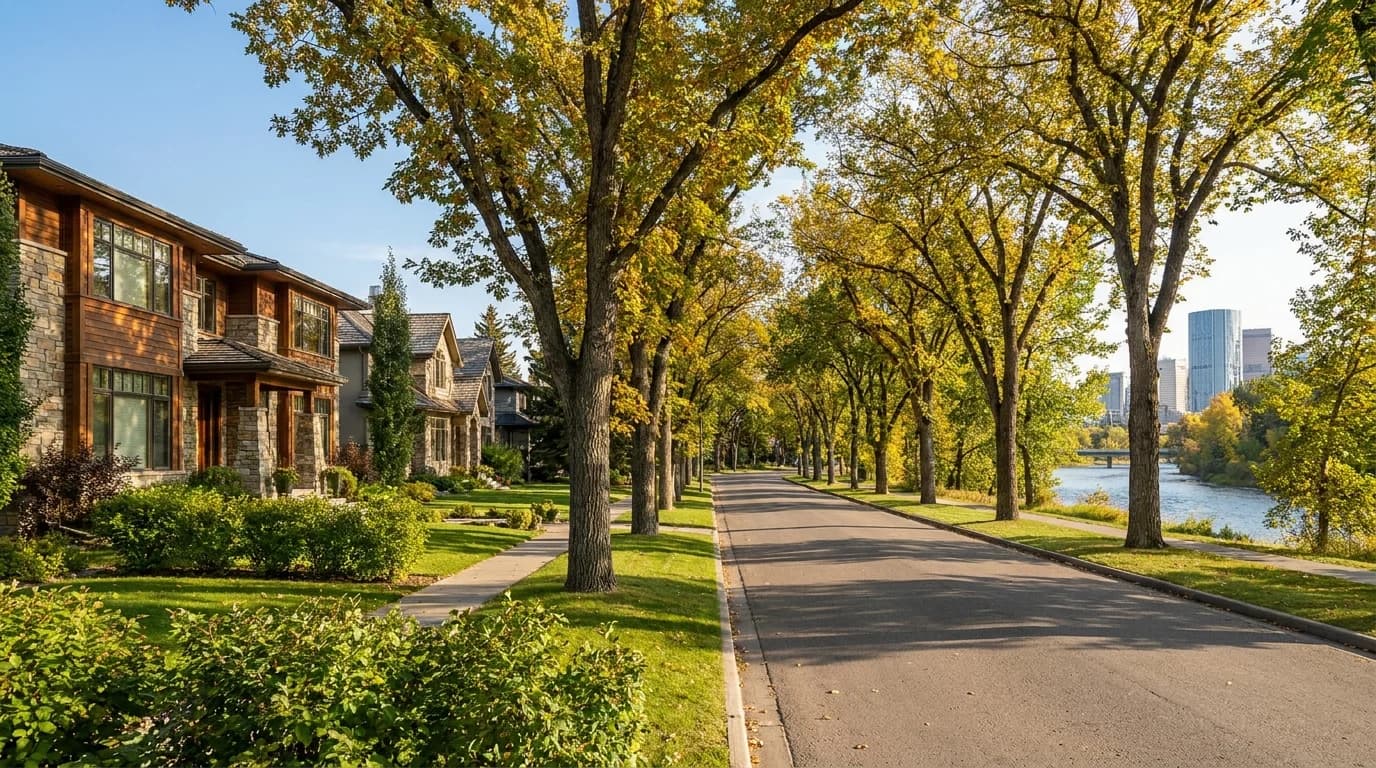
Walk a block off Elbow Drive and you feel the difference. Mature trees arch over the pavement, and the roads curve rather than run in a grid. The river pathway sits a short walk from most addresses. You can walk to the river, to the school, and to a neighbour's kitchen. For groceries and coffee, though, most people drive a few minutes or head over to Britannia.
What Kinds of Homes Come Up for Sale in Elbow Park?
Three kinds of homes trade here: original character houses, heavily renovated ones, and full rebuilds. The mix also explains why two houses on one block can sell for different numbers.
Elbow Park holds roughly 1,145 occupied private dwellings. Of those, 98% are single detached houses, while the citywide share sits at 55%. Age matters even more: 55% of local homes date from 1960 or earlier, against 9% across Calgary. That gap is why I raise the renovation question at almost every showing. You can browse current Elbow Park Calgary homes for sale through my custom property search.
The wider market gives you a frame to start from. CREB's August 2026 statistics put the detached benchmark in the City Centre district, which takes in Elbow Park, at $995,700, up 2.24% on the previous August. Across Calgary the detached benchmark instead slipped 1.09% to $744,300 over the same year. Read that district figure as a floor rather than a guide, because Elbow Park trades above it and the district blends in communities nothing like this one.
Character houses
You walk into deep eaves, real plaster, wood windows, and rooms sized for a different way of living. Many have grown through additions layered on across decades, so floor plans wander. I walk them slowly, checking the mechanical room, the roof line, and the basement corners first, because deferred work shows up there.
Renovated homes and rebuilds
Plenty of owners here have already done the work. Some took the house down to the studs, and others replaced it outright. Still, quality runs from excellent to alarming. So I ask who built it, whether the permits closed properly, and what the builder did about drainage. A new kitchen tells me nothing about the weeping tile.
The word renovated covers a lot of ground in this community. Sometimes it means fresh paint and a new countertop. Other times it means new wiring, new plumbing, new windows, and a rebuilt foundation. For example, two homes marketed with the same word can sit ten years apart in condition. Instead of trusting the word, I read the permit history first.
River backing estates
The top of the market sits on the larger river backing lots. Trees are mature there, and the outlook stays private. These Elbow Park estate properties trade rarely, so comparable sales stay thin. I price them on judgement rather than arithmetic. Buyers at this level choose a setting first and a floor plan second.
| Home type | What you get | What I check first |
|---|---|---|
| Character house | Original craftsmanship, mature street, smaller footprint | Mechanical age, roof, foundation, past additions |
| Renovated or rebuilt | Modern layout and systems on an established lot | Builder record, closed permits, grade and drainage |
| River backing estate | Privacy, outlook, and a lot nobody can replicate | Bank stability, insurance appetite, thin comparables |
How Do Elbow Park and Britannia Compare?
Both communities sit on the Elbow River and share the same established inner city feel. Britannia is smaller and flatter, while Elbow Park spreads wider and still shifts character from street to street.
Buyers shop them together, so I show them together. Britannia offers the plaza at its doorstep, which suits people who want coffee and groceries on foot. Elbow Park, on the other hand, gives you more variety in lot shape, elevation, and architecture. The search takes longer here, and the range of outcomes is wider.
Lot orientation is the detail buyers overlook most. A south or west facing back yard changes how a house lives through a Calgary winter. I check which way the yard faces before we drive over, and I also look at whether the garage sits off a lane or off the street.
Anyone comparing Britannia Elbow Park homes should walk both at the same hour of the same day. Traffic patterns, tree cover, and afternoon light differ more than any listing photo shows. The two communities draw different buyers. Britannia leans toward downsizers who want walkability, while Elbow Park attracts families who want space and a yard.
What Should Buyers Know About the Elbow River and Flooding?
Buyers ask about flooding before they ask about anything else. The river is why people love Elbow Park, and it is also the risk you have to underwrite.
During the June 2013 flood, the Elbow River peaked at 1,240 cubic metres per second. That was roughly 12 times its regular flow rate, and 26 communities went under evacuation orders. Those figures come from the city's own record of Calgary's flood history.
Alberta has built real protection since then. The province owns and operates the Springbank Off-Stream Reservoir, which engineers designed to work alongside the Glenmore Reservoir. Together the two can hold back water volumes equal to the 2013 flood on the Elbow. Still, protection differs from immunity, and I say so up front.
Insurers and lenders keep asking their own questions. Their answers vary house by house rather than street by street.
My checklist near the river
- First, locate the property on current provincial flood mapping and note where it sits.
- Next, get an insurance quote in writing before the condition date rather than after.
- Confirm the lender's appetite early, because terms can shift for river adjacent addresses.
- Walk the grade and drainage around the whole house, including the side yards nobody photographs.
- Ask what happened here in 2013, what the owners rebuilt, and whether the permits closed.
- Request repair invoices, engineer reports, and permit records from the seller.
- Check for a sump pump and backflow protection, then confirm somebody services them.
- Finally, look at what the neighbours on both sides have done, since drainage ignores property lines.
None of this should scare you off. You are instead moving the risk from unknown to known, which is the point of a condition period. My buyer intake form starts this conversation before we book a showing.
How Should I Price an Elbow Park Home to Sell?
Price from the lot and the street first, then adjust for the house. A per square foot average will mislead you more often than it helps in a community this small.
Thin comparables cut both ways. Both sides will point at one recent sale two blocks over. I check whether that house resembles yours in lot width, exposure, and finish. Sellers who skip this step list high, sit, and then chase the market down. A well prepared home at a defensible number instead draws attention in its first ten days. The City Centre district carried 3.84 months of supply in August 2026 against 3.39 across Calgary, so buyers here have marginally more room than the city average suggests.
Preparation still pays more here than in newer neighbourhoods. You get more for a character home after careful staging, honest photography, and small repairs. An experienced Elbow Park realtor will also time the launch against the spring market. We watch what else looks ready to list nearby.
Offer strategy matters as much as list price. Buyers in this pocket often want a long condition period for inspection and insurance. Sellers who plan for that up front negotiate from a calmer place. The cleanest deals I have written here still started with a seller who had already gathered permits, warranties, and receipts. If you want a starting number, my free home evaluation is the fastest way to get one.
Why Does the Right Elbow Park Real Estate Agent Matter?
You are buying local memory as much as service. A good Elbow Park real estate agent knows which rebuilds hold up, which lots have grade problems, and which owners are quietly thinking about selling.
I have spent years walking these blocks, and it shows up in small ways. I can also tell you which builder did the house you like. I can tell you why one street floods at the curb after a hard rain. My clients then spend less time chasing listings that were going nowhere.
Ask any agent you interview how many homes they have walked in this community. Then ask what they think of the last three sales on the street you like. Their answers will show you whether they know the place. Local knowledge is the thing you are actually hiring.
Houses come up here at their own pace, so plan for patience rather than speed. Sort out your financing, your insurance, and your priorities early. Next, be ready to move when the right house appears. I work with buyers and sellers across Calgary's inner city, and I am happy to walk a few blocks with you before you commit to anything.